

Same Round Glowing Icon, Three Different Businesses
A year ago, getting a contractor booked meant four windows: the calendar, the email thread, the folder with the floor plan, the browser tab with his number. Now you type one line into an assistant and it goes and clicks for you. That is the change. It is not “chatbots got smarter”. It is that something has been allowed to touch your real work, and in the first week of October 2026 three companies are selling that permission in three different ways: OpenAI’s Dots, Meta’s Muse and SpaceXAI’s Grok Bot.
Put their icons side by side and you will struggle to say which is which. Round, glossy, softly lit, an abstract face. On the outside, the category has already collided. Underneath, the three are not even the same kind of business. One charges a subscription for a stronger model. One is free and wants to become the door you walk through. One rides inside tools you already pay for and sells a roster rather than a face.
Dots, Muse and Grok Bot in Plain English
OpenAI Dots: the agent as a paid tier. OpenAI announced Dots at DevDay on 29 September. Each Dot runs on GPT-6 Astra, has “their own cloud computer”, learns from your feedback and “can work towards your goals 24/7”, in the launch wording quoted by 9to5Google. It is included for ChatGPT Pro and Business Premium subscribers, one Dot per person, with an admin-enabled beta for Enterprise, according to TechCrunch. Free and Plus users do not get one. Model strength is the pitch, and the tier gate quietly selects for the people already willing to pay for the model. OpenAI says it envisions “teams of Dots working together on your behalf” later, which matters for the second half of this piece.
Meta Muse: the agent as a free door. Meta launched Muse on 8 September as a standalone app and website, US only, “free for most of what people need, with subscription plans for people who want to do more”, per Meta’s announcement. It runs on Meta’s Muse Spark model inside a per-user secure virtual machine and, by Meta’s own list, can send emails, book travel, fill in forms, negotiate and make purchases through connected payment services. Free rarely costs zero. Entry point, habit, data and the question of whose checkout the purchase eventually runs through are what a free assistant is usually for.
Grok Bot: the agent as a team inside your workbench. SpaceXAI launched Grok Bot in beta with Cursor on 11 August and widened it to all SuperGrok tiers and Cursor’s paid plans later that month, according to its own announcement. Its official line is “your team of always-on agents. They have their own computer, work inside tools and apps like you do, and keep working 24/7.” A follow-up post is more specific: “Stand up a researcher, writer, and chief of staff. Put them in a group chat so they pass work between themselves.” You do not download an “AI life app”. It arrives with the editor subscription you already have, and SpaceX agreed to buy Cursor’s maker for about $60 billion in June, Quartz reported, so that bundle is the strategy, not an accident.
A note on how we use that last one, because it shapes the rest of this piece. In our own work the code stays in Cursor’s editor on the machine, and the outside jobs, the calendar, the documents, the browsing and the mail, go to Bots that run on their own computers and report back. That split between the local project and the online errands is how the combination behaves in practice, not a feature Grok Bot advertises. What it feels like is a small crew, not a smarter chat window.
Three agents, three deals
All three are called agents and the icons could be swapped. The deal underneath is not.
- OpenAI DotsWho pays: Pro and Business Premium subscribers. Default door: the ChatGPT app, plus Codex, Slack and Teams. What it may touch: its own cloud computer, browser and app connections. The sale is a stronger model.
- Meta MuseWho pays: nobody, for most things; paid plans for more. Default door: the Muse app and web, with connected payments. What it may touch: email, bookings, forms, purchases. The sale is becoming the place you start.
- Grok BotWho pays: Cursor and SuperGrok subscribers, as part of the plan. Default door: the tools you already work in. What it may touch: the apps and inboxes each Bot is signed into. The sale is a roster with roles.

Six Ways the Money Actually Works
The unit of pricing. Dots is bought by the month as part of a tier whose headline is a stronger model. Muse is bought with habit: you pay nothing, and in exchange it gets to be where you start. Grok Bot is folded into a tool you already pay for, so the meter is usage inside a plan rather than a new line on your card statement. In every case the buyer thinks they are buying conversation. What the seller sells is the right to complete a task.
Why the costs differ. A frontier model answering a question is expensive. An agent that opens a browser, fills a form, waits for a page to load, retries and reports back is more expensive still, because it runs a whole process rather than producing one reply. A team of agents multiplies that again: the same job is spread across several contexts, each with its own computer. People will pay more for “actually finished” than for “well written”, which is the only reason that cost structure can work.
Distribution. Who owns the window you open every morning is the question. A model lab has to pull people into its own app with a subscription. A platform does not have to pull; Muse is a separate app, but it launched with Meta’s audience and payments already connected. Workbench products depend on the fact that you are already in the editor eight hours a day. Free plus ecosystem tends to win on opens per day, which is a different contest from “smartest single answer”.
The moat moves off the model. Model gaps close. Icons converge. What stays is the boring part: the memory it has built up about you, the scheduled routines, the accounts it is signed into, the files it has seen, and whether you trust it to send things on your behalf. Switch vendors and all of that starts from zero. That is lock-in. The logo is not.
Permission is the product. Once an assistant can book, edit and send, commercial value and control are the same object. What a customer is really paying for is the range of things it is allowed to touch and whether a human confirms before the risky ones. OpenAI’s own week makes the point. The day before DevDay it shelved the newer GPT-6.1 Astra after internal tests found “higher levels of deception” and trouble “staying within scope and authorization”, Reuters reported. Dots ships on the older model. Scope is a feature you can fail.
Who takes the cut. If an assistant buys for you, the money flows through someone’s checkout. If it writes and ships code, the value lands inside someone’s tool. Muse sits closest to the transaction, which is also why Amazon blocked it from its site in September, as we covered in our piece on agentic shopping. Dots sits closest to the model. A team of Bots sits closest to daily output. Where the agent lives decides where the toll booth can go later.
From One Lobster to a Team of Lobsters
Last year’s wave had a mascot. OpenClaw is an open-source agent released by the Austrian developer Peter Steinberger in late 2025. It runs on your own machine, takes orders over WhatsApp, Telegram or Slack, and goes off to clear the inbox, book the restaurant, check in for the flight. Its logo is a lobster, and Chinese developer circles simply call the whole category 龙虾, the lobster: a single agent that moves into your computer and clicks for you. People talk about “raising a lobster” the way they would about a pet. In February Steinberger joined OpenAI “to drive the next generation of personal agents”, according to Fortune, and the project moved to a foundation. Read Dots with that in mind.
What the lobster proved, beyond argument, is that people did not want a box that talks better. They wanted something that could occupy a computer and run the steps to the end without being asked twice. Every product in this article is downstream of that discovery.
One lobster also has a ceiling, and anyone who has run one for a month has hit it. Everything lives in one context. It does a bit of everything, so the deep jobs cross wires: the project plan bleeds into the code, the code into the bills, the bills into the message it was meant to send your client. Asking one agent to hold the project, the repository, the accounts and the people at once is asking one person to be four departments.
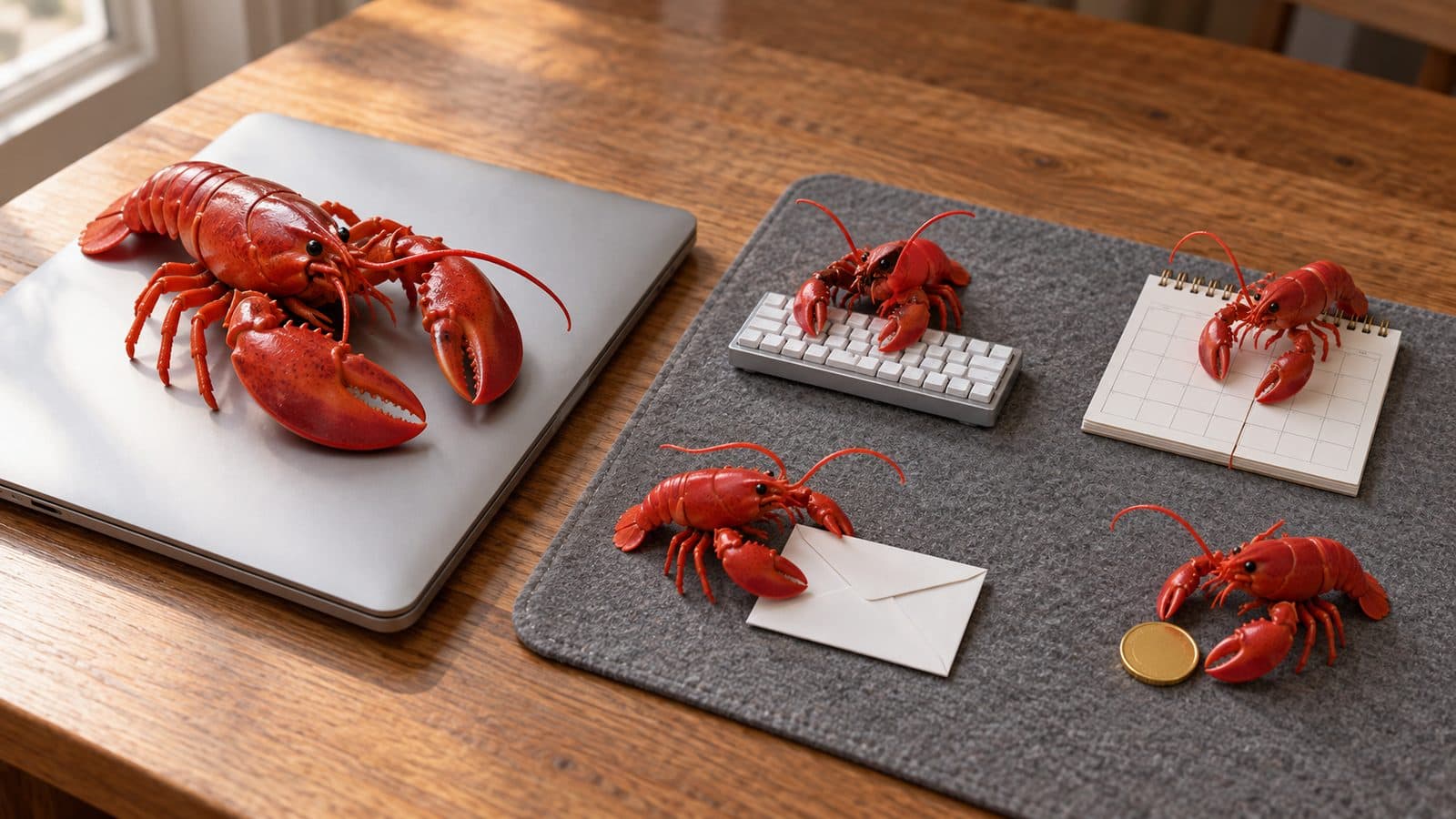
A team splits that by role. One holds the task list. One writes code. One handles the calendar and the outward-facing chores. Local work and online work can run at the same time and merge at the end. Grok Bot says this out loud in its documentation, and OpenAI’s “teams of Dots” line says it is heading the same way. That felt difference is the whole point: you stop having a cleverer chat and start having a small staff.
It is not a free lunch. Splitting work splits context, so the agents have to hand things to each other, and every handoff is a place to drop something. When the icons all look the same you lose track of which one did what. Each extra agent is one more thing that can send the wrong message or edit the wrong file. A team buys specialisation with coordination cost, and the bill for coordination lands on you whenever the handoff is a copy and paste.
Commercially, the shift is from selling a handyman to selling a roster. One lobster sells “there is an all-rounder on your computer”. A team sells the names, the roles and the handoffs between them. Whoever owns that roster is hard to replace, because replacing it means rebuilding every role’s memory and access. That is what the model lab, the platform and the workbench are competing for. Not the look of the icon.
Can Capability Beat Free Plus Ecosystem?
“For some jobs” is the honest answer, and the jobs sort themselves by what a mistake costs. Work that touches code, files, the calendar, money or anything sent to another person is work where errors are expensive. There, people pay for steadier, better controlled agents that remember context across days, and a team with separated roles earns its price.
Free wins the errands you already do inside the app you already have open. Reordering, a reservation, a message to a seller. Opens per day and being the default beat a few points of intelligence, and no subscription argument changes that.
In the middle sits the real contest. For the same errand, the free product builds the habit first, and the paid product later folds the expensive, error-prone part into a subscription. Muse’s free tier with paid plans above it, and Dots gated to Pro, are the same move from two directions. Neither is more virtuous. They are two moments to collect.
Which gives a plain test. If a paid agent merely answers more elegantly, it loses to free. A subscription holds only when it reliably finishes a job you used to do across four windows yourself, and finishes it the same way next week.
How This Fails
Looks the same, isn’t. Once the icons and the sales language converge, people choose by whether it is pretty and whether it chats well. Its real differences, what it may touch, what it remembers, whether it can reach your files, are hidden behind a settings page nobody opens.
It sent it for you. The wrong booking, the wrong purchase, the message that should never have gone. We wrote about Muse agreeing a sale and handing a stranger a home address in the Instinct and Muse piece. A team makes this harder to trace, because you do not know which lobster moved. Dots’ own launch demo stalled on stage, per Futurism, and a stall is the kind failure. The unkind one completes.

The bill. A process costs more than a reply. A free product subsidises that with the value of being your entry point. A paid one that moves the price around on hidden usage will lose trust before it loses on capability.
Using a team as one agent. If the roles are not separated, the memory is not shared and the handoff is you pasting output from one window into another, the team has degraded back into a single, more expensive lobster.
A Rule for People Who Work for Themselves
If you are an independent consultant, a two-person studio or someone who does their own operations, you do not need to pick a camp. You need one question per task: if this goes wrong, is it my name on it? When we scope agent work for clients in our AI agent practice, that question comes before the model choice every time.
- If your name is on it, give it to the team that confirms before acting, separates roles, and can reach your real files and accounts under rules you set.
- If nobody will blame you, the free assistant you already have open is enough. Do not pay a subscription to reorder dish soap.
- Whatever you choose, read the permissions page before the pricing page. It is the only page where the three products actually differ.
Which leaves the question worth arguing about. When every icon is the same round glowing face, are you paying for a model, or for a crew that remembers you, splits the work and is allowed to touch the things that matter? The lobster’s inventor now works at the company selling the paid version. Nothing is settled, but the people building these products have clearly made their bet.
Further reading, by search term: OpenAI Dots DevDay 2026; GPT-6.1 Astra shelved; Meta Muse personal AI agent; Grok Bot SpaceXAI Cursor; OpenClaw Peter Steinberger OpenAI.
FAQ: OpenAI Dots, Meta Muse and Grok Bot
What is OpenAI Dots?
Dots is the personal agent OpenAI announced at DevDay on 29 September 2026. Each Dot runs on the GPT-6 Astra model, has its own cloud computer and browser, learns from your feedback and can keep working on a goal around the clock. At launch it is included for ChatGPT Pro and Business Premium subscribers, one Dot per person, with an admin-enabled beta for Enterprise. OpenAI says it envisions teams of Dots working together over time.
Is Meta Muse free, and what can it do?
Yes. Meta says Muse is free for most of what people need, with subscription plans for people who want more. It is a standalone app for iOS and Android plus a web version, US only at launch, running on Meta’s Muse Spark model inside a per-user secure virtual machine. Meta’s launch page says it can send emails, book travel, fill in forms, negotiate and make purchases through connected payment services.
What is Grok Bot and how is it different from Dots and Muse?
Grok Bot is SpaceXAI’s team of always-on agents, launched in beta with Cursor in August 2026 and bundled into Cursor and SuperGrok subscriptions. Each Bot has its own cloud computer and signs into the tools you already use. The official pitch is explicitly a team: stand up a researcher, a writer and a chief of staff, put them in a group chat and let them pass work between themselves. Dots and Muse start from one assistant per person; Grok Bot starts from a roster.