
Two Receipts for the Same Hunger
Everyone counts the accelerators. Who trained the bigger model, who bought more accelerators, how many racks went into which hall. Nobody photographs the memory bolted next to the processor, and yet that is the part that ran out first. In the same week, the AI memory shortage produced two receipts: Micron’s customers have now committed about $32 billion, mostly as cash paid in advance, and South Korea shipped a record $120.94 billion of exports in a single month, nearly half of it chips. Read them as two sightings of one animal.
A picture to hold. A cluster of accelerators is a kitchen full of fast cooks. The model’s weights are the ingredients, and they have to be on the counter, not in the storeroom. If the counter is small or the runner is slow, the cooks stand there with knives in hand. Memory is the counter. For two years the industry has been buying cooks. The counter is the bill that arrived afterwards.
Why Did Memory, Not Just Chips, Become the AI Bottleneck?
Start with the physics, because everything else follows from it. A large model is billions of numbers, and each step of training or answering a question reads a great many of them and writes intermediate results back. Compute got fast enough that moving the data became the slow part. An accelerator that waits for memory is an expensive heater. So once the models grew, the thing that had to scale next was how much data could sit right beside the chip and how quickly it could be fed in.
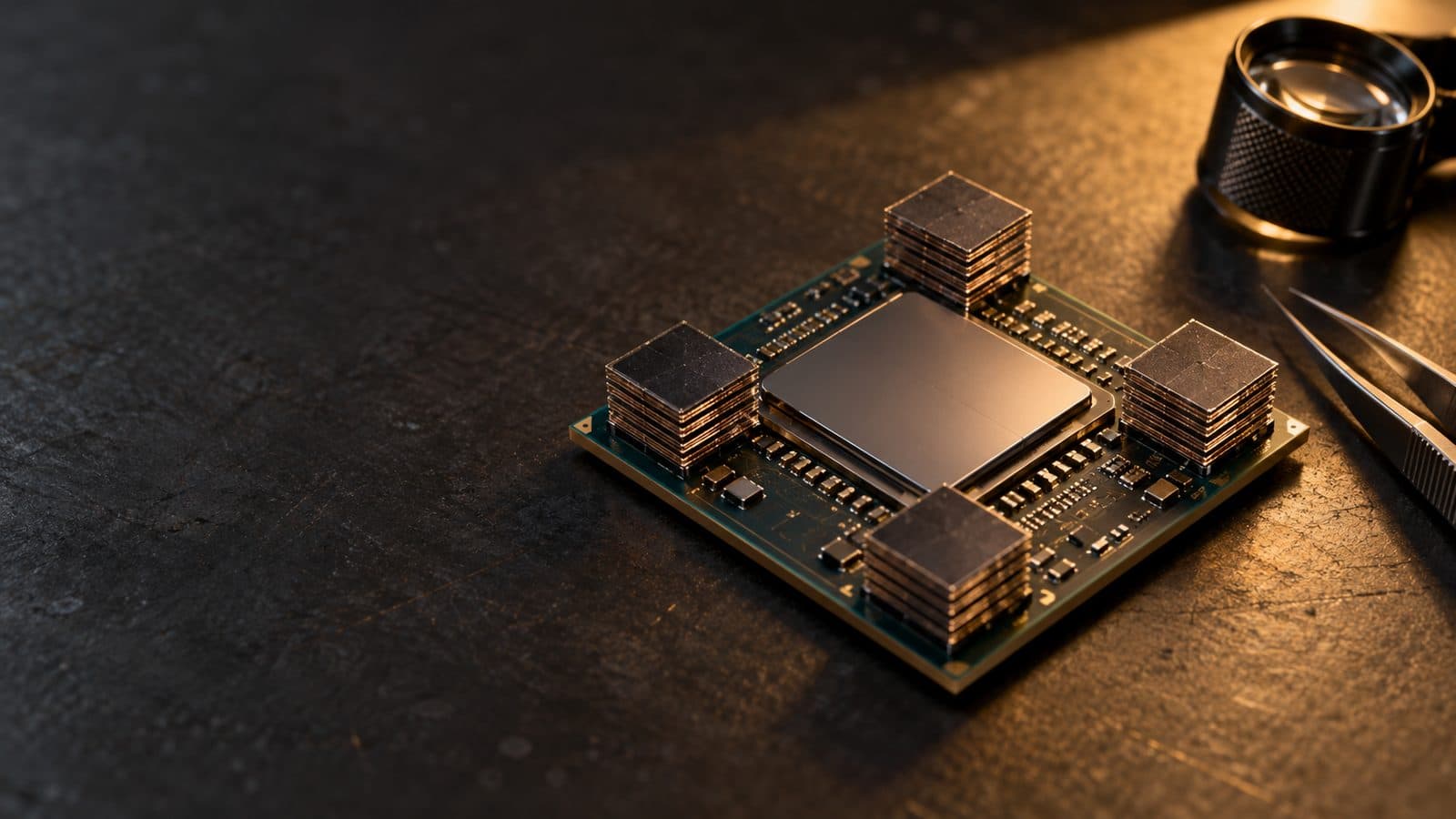
That is what HBM is for. High-bandwidth memory stacks several memory dies on top of one another and wires them to the processor through a channel many times wider than an ordinary memory slot. Ordinary memory is a warehouse shelf: huge, cheap per box, a walk away. HBM is the workbench at the machinist’s elbow: small, costly, and the only place where the tools are close enough to use at speed. It is also harder to build: stacking dies and packaging them next to a processor is limited by yield, and yield does not improve by adding floor space. That constraint is the whole reason China’s attempt to build its own HBM supply is the hardest part of its chip push.
Why Customers Now Pay Years in Advance
Because that supply cannot double next quarter, the buyers changed how they buy. Cloud providers and model companies started locking up years of output in advance, and the memory makers started asking for money up front. That is what Micron’s number describes. On its earnings call on 30 September, chief executive Sanjay Mehrotra said “customer financial commitments have grown to $32 billion, with the majority in the form of cash prepayments”, as the Korea Herald reported, up from $22 billion in June according to Reuters. The company calls the contracts behind that figure strategic customer agreements, and says there are now 26 of them, up from 16 a quarter earlier.
Hold on to what that figure is and is not. It is not revenue. Money handed over in advance to reserve supply is a deposit against future shipments; it tells you how far ahead customers can see, and how afraid they are of standing in line later. For Micron it is order visibility. For the customer it is insurance. The two meet in the same number and mean different things.
Why Did Korea’s Exports Hit a Record in September 2026?
Then the goods leave the factory, and they show up in a different ledger: the exporting country’s. On 1 October the Ministry of Trade, Industry and Resources said South Korea’s September exports hit $120.94 billion, up 83.5% from a year earlier, a record, according to the Korea Times. Semiconductors were $60.3 billion of it, up 262.8%, the first time any single category has passed $60 billion in a month, on “higher export volumes and rising contract prices” for memory. That is the demand after it has passed through a fab and become freight. Semiconductors are about half of Korea’s exports; the $120.94 billion is the whole country’s shipments.

Keep the stock market and the bond market apart, because they said different things that morning. Reuters’ Asia wrap had the Nikkei up more than 3% and the KOSPI up 1.7% on Micron’s results, while US Treasuries were nursing “their sharpest quarterly selloff in more than three decades” as high energy prices kept inflation risk alive. The companies on the memory chain can see their orders. The price of money is a separate conversation, and it was pulling the other way.
What Micron’s $32 Billion Actually Is, and What Is Confirmed
Short, because the point of this section is what not to say.
The numbers, as stated by their sources
Company figures are from Micron’s 8-K press release and earnings call; export figures are the Korean trade ministry’s as reported by Korea Times and Korea Herald.
| Item | Figure | Source and date |
|---|---|---|
| Micron fiscal Q4 2026 revenue | $54.23B | 8-K press release, 30 Sep |
| Micron fiscal 2026 revenue | $133.19B | 8-K press release, 30 Sep |
| Next-quarter guidance | $61.5B ± $1.5B | 8-K press release, 30 Sep |
| Customer financial commitments | $32B, mostly prepayments (from $22B) | Earnings call, 30 Sep |
| Fiscal 2027 output already secured | More than 75% | Earnings call, 30 Sep |
| Korea exports, September | $120.94B, +83.5% y/y, record | Trade ministry, 1 Oct |
| Of which semiconductors | $60.3B, +262.8% | Trade ministry, 1 Oct |
| Working days in the month | 21.5, down 3.5 y/y (Chuseok) | Trade ministry, 1 Oct |
Also confirmed: Micron said the vast majority of its calendar 2027 HBM supply is already contracted “with significant price increases year-over-year”, that it has no line of sight to when supply and demand balance, and that fiscal 2027 capital spending should exceed $50 billion, all from the call as The Next Web and the Korea Herald reported it. Its shares were little changed after hours.
Not confirmed, and so written here only as open questions: how much of the $32 billion is HBM rather than ordinary DRAM; how much of it could be cancelled or deferred; what share Samsung and SK hynix take of the Korean figure; and whether a $120 billion month can repeat. Anyone who gives you a number for those is guessing.
Six Layers Under the HBM Shortage
Technical: the bottleneck moved from computing to feeding
The constraint has moved from “can it compute” to “can it be fed”. Processor and memory now ship as a pair, and the pair is only as fast as the slower half. Memory decides what fraction of a cluster’s hours are spent computing and what fraction waiting, which makes it a throughput decision before it is a cost line. We see this in client work with no exotic hardware at all: a longer context window or a bigger retrieval index raises the memory bill long before anyone asks for another accelerator.
Capacity: why supply bends slowly
The hard part of HBM is stacking and advanced packaging, not switching on another hall. That is why customers pay in advance: supply bends slowly, and the only way to be sure of next year’s share is to reserve it now. Industries with stiff supply behave the same way every cycle. Prices and lead times tighten together, then loosen together, and the swings are larger than anything in software. Micron saying it cannot see the balance point describes that stiffness.
Supply chain: profit and bottleneck move to memory
For two years the AI story was told through the company that designs the accelerator. Memory redirects part of the profit and part of the bottleneck to the firms that make and package the chips beside it. The Korean figure is the macro reading of that redirection. A country can design none of the famous processors and still sit on the critical path of every training run because it remembers fast. SK hynix posted its fifth straight record quarter in July and has begun shipping HBM4 in volume, as UPI reported.

Customer behaviour: a prepayment is fear with a dollar sign
People who are afraid of being shut out over-order, and over-ordering looks, from the outside, like demand that only goes up. Reserving years of supply borrows future need and books it today. The mechanism runs in reverse just as cleanly: if model companies slow their capital spending, the commitments can fall before the actual usage does, because a reservation is cheaper to cancel than a rack is to switch off. The $32 billion measures what customers fear; what they will use is a different number.
Macro: a steep number and a bond market saying something else
An 83.5% jump is steep enough to need explaining, and the ministry’s own release explains part of it the other way. September had 21.5 working days, 3.5 fewer than a year earlier because the Chuseok holiday fell in September this year, so exports per working day rose about 105%. Volumes and prices are both in the number and the release does not separate them, so this post does not either. Meanwhile the bond market was telling a different story: the Reuters wrap called it the sharpest quarterly selloff in over thirty years, and Trading Economics put the 10-year Treasury near 5.3%. Higher rates compress long-duration growth stories even when the orders are real, which is why Micron’s own shares barely moved after hours: the memory story was already priced, the rate story was not. The memory chain can be smiling while the broad market is not, and both readings are correct.
Builders and small companies: memory is now a line in your bill
None of this says buy memory stocks. It does say your cost intuition is out of date. In an AI bill, memory and data movement are becoming a line you cannot round away, and when cloud providers lock in higher prices for years they pass them down. API prices and compute rents will not track the GPU alone. TrendForce expects general DRAM contract prices to rise another 10 to 15% in the fourth quarter, per its 30 September note, and that is the kind of number that ends up inside your per-token price without a label on it.
How to Read the Memory Shortage Without Buying Anything
Three words get blurred in every earnings headline, and keeping them apart is most of the skill. Revenue is what has been sold. Commitment is what someone has promised to buy, sometimes with a deposit. Demand is how hungry the buyer says it is. Micron’s $32 billion is the second word. Its $54.23 billion quarter is the first. Nothing in the release is the third.
- Reading an export print, ask four things before reacting: value or volume, whole country or one product, how low was last year’s base, and how many working days. September’s 83.5% belongs next to the record $120.94 billion and the 21.5 working days, never on its own.
- Building an AI product, write memory and data movement into your cost model now. A bigger model, a longer context and more retrieval each push that line, not just the compute line.
- Watching markets, let two things be true at once. Good news for the memory chain and a bond selloff pressing the wider market do not cancel; one headline is not allowed to overwrite the other.
We help teams size this kind of infrastructure spend before they commit to it, which is why the question we ask first in our cloud infrastructure work has shifted from “which GPU” to “how much has to sit next to it, and for how long”. The same logic is driving the debt-financed GPU builds in our October funding round-up .
No price forecast, then. One question instead. When customers race to reserve years of memory in advance, is the $32 billion the floor of AI demand, or a ceiling that panic has pulled forward into the present? The export figures say the goods are real and moving. The prepayments say the buyers are scared. Both are facts. Which one you weight more decides what you think happens in 2028, and the people with the most money on the table have, so far, declined to say.
Further reading, by search term: Micron fiscal Q4 2026 results; Micron strategic customer agreements prepayments; Korea exports September 2026 record; Korea semiconductor exports $60 billion; HBM shortage 2027 2028; TrendForce DRAM contract prices Q4 2026.
FAQ: Micron, Korean Exports and the AI Memory Shortage
What did Micron report in its fiscal Q4 2026 earnings?
On 30 September 2026 Micron reported record fiscal fourth-quarter revenue of $54.23 billion and full-year revenue of $133.19 billion, and guided the next quarter to $61.5 billion plus or minus $1.5 billion. On the call its CEO said customer financial commitments, mostly cash prepayments under strategic customer agreements, had grown to $32 billion, up from $22 billion in June, that more than 75% of fiscal 2027 output was already secured, and that the vast majority of calendar 2027 HBM supply was contracted at significantly higher prices.
Why did South Korea’s exports hit a record $120.9 billion in September 2026?
September exports reached a record $120.94 billion, up 83.5% from a year earlier, according to the trade ministry’s 1 October release. Semiconductors were $60.3 billion of that, up 262.8%, the first time any category passed $60 billion in a month, on higher memory volumes and rising contract prices. The month had 3.5 fewer working days than a year earlier because the Chuseok holiday fell in September, so exports per working day rose about 105%.
Why is there an HBM shortage, and how long will it last?
High-bandwidth memory stacks several memory dies and feeds the processor through a very wide channel, so large models can keep their weights and intermediate results close to the compute. It is harder to make than ordinary DRAM because stacking and advanced packaging limit yield, so capacity grows slowly while AI demand grows fast. Micron said on 30 September 2026 that the vast majority of its calendar 2027 HBM supply is already contracted at significantly higher prices and that it has no line of sight to when supply and demand will balance; it expects supply to be tighter in fiscal 2027 and 2028 than in 2026.
What is Micron’s $32 billion customer commitment?
It is the total of what customers have committed to Micron under strategic customer agreements, most of it as cash paid in advance to reserve future supply, as the CEO described it on the 30 September 2026 call. It rose from $22 billion in June, and the number of such agreements went from 16 to 26 in a quarter. It is a deposit against future shipments and a measure of order visibility; it is not revenue, which Micron reports separately ($54.23 billion for the quarter).